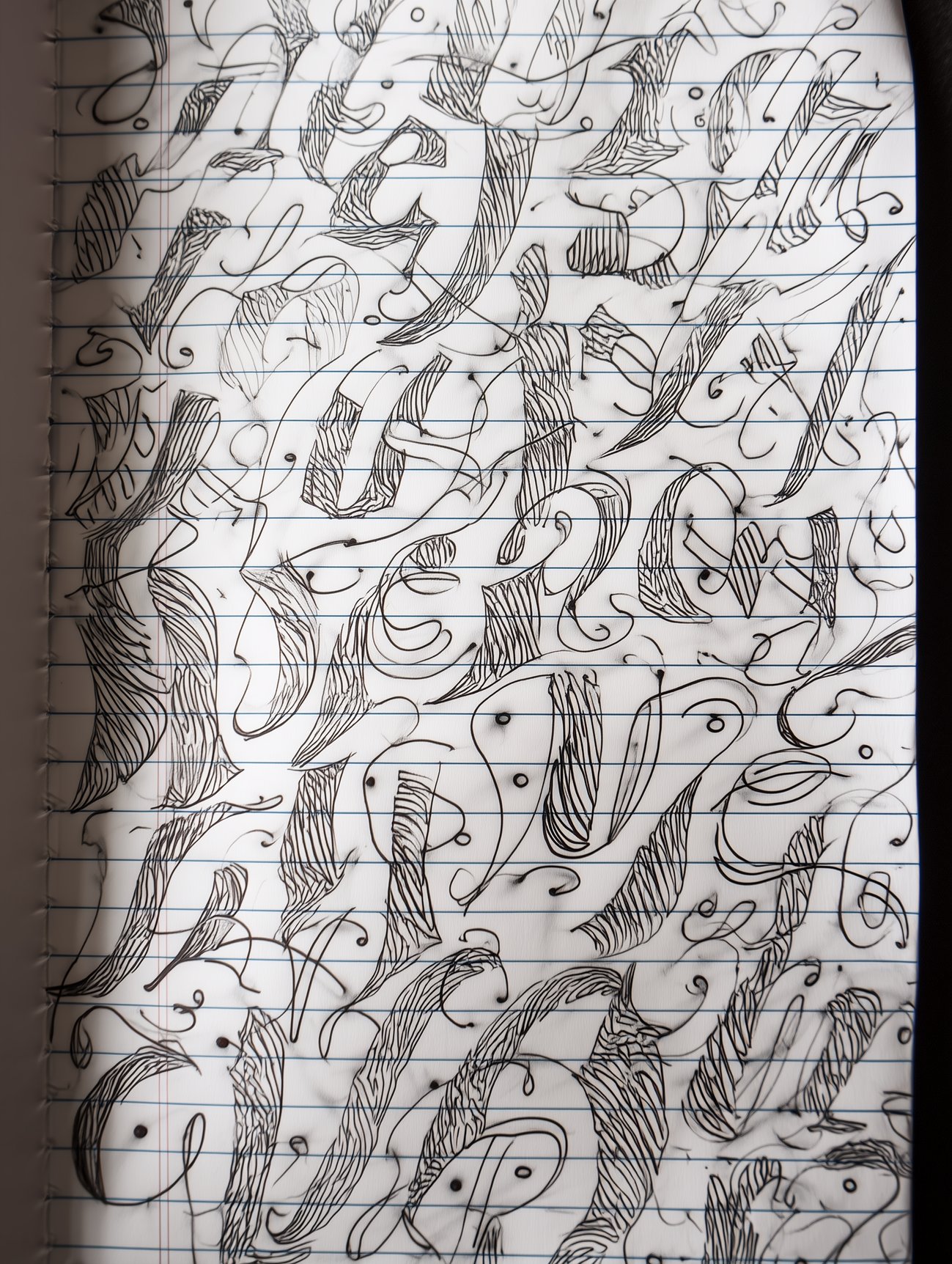
A swirling entanglement of looping ascenders and descenders, suggestive of a cursive script grown unstable. Certain glyphs repeat with variant ornamentation, resembling incantatory refrains. Lineation is vertical, denying the Western left-right reading axis. Scholars have linked this style to the trance-writing of mediumistic artists like Augustin Lesage and Madge Gill.
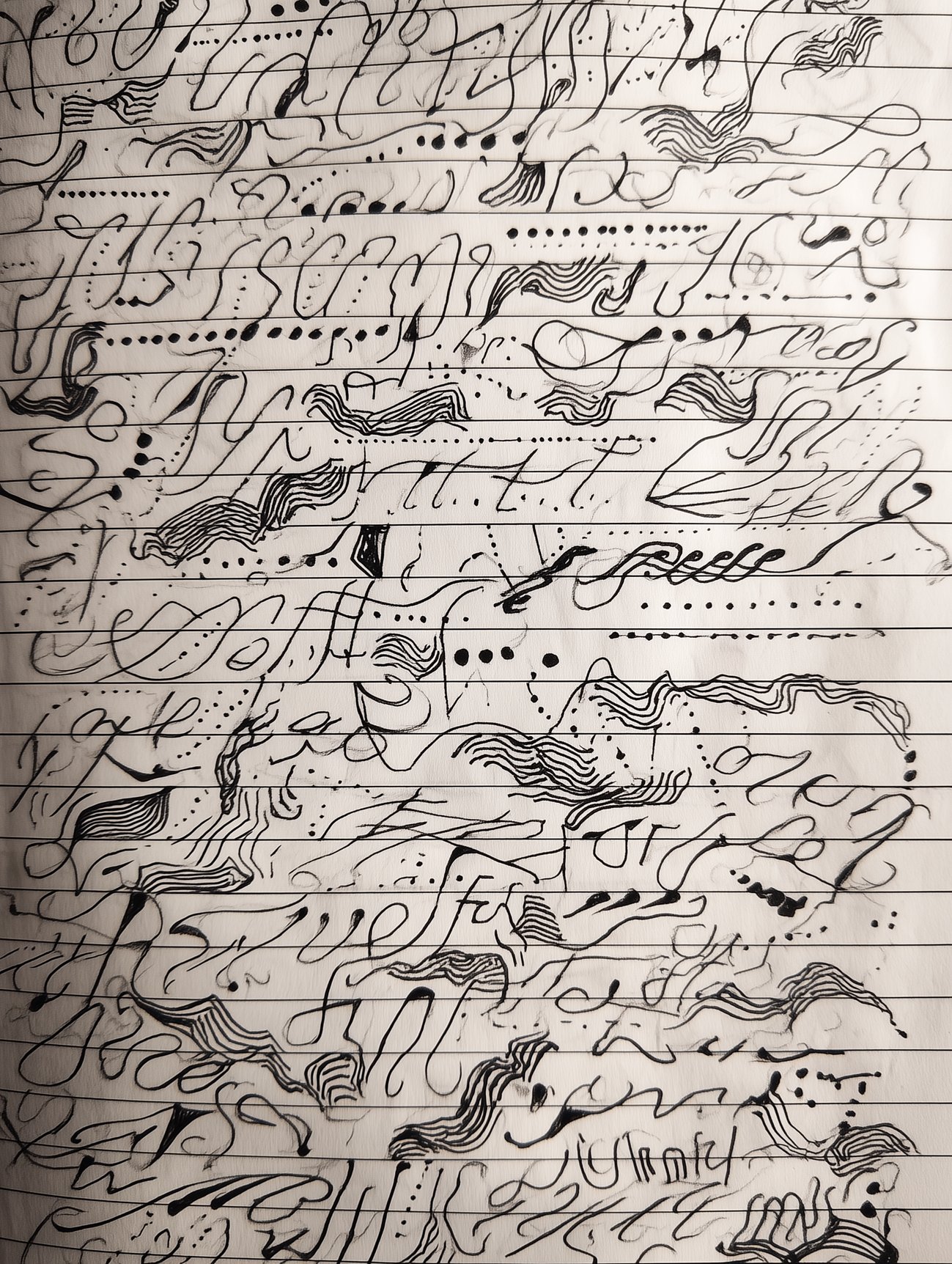
Rows of fluctuating density, invoking tape-wave sonography or encoded birdcalls. Dot clusters and flickering ligatures suggest a rhythmic or musical interpretation—possibly a form of graphic notation. Composer Janina Solheim has compared it to the calligraphic scores of Cornelius Cardew (Treatise, 1967).
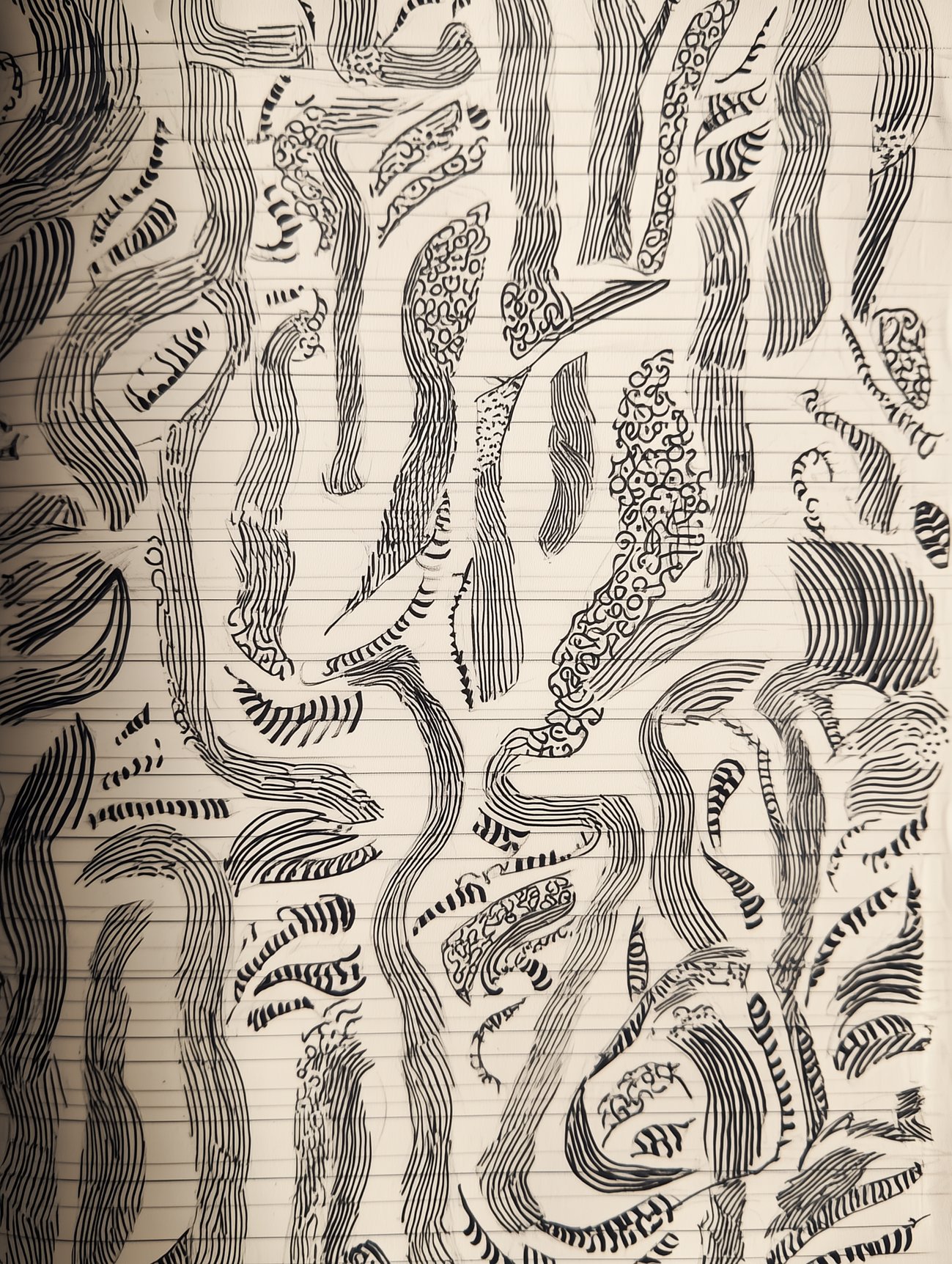
A fully immersive field of filaments, coils, and undulating pulses. The density of mark-making mimics mycelial networks, drawing comparison to fungal thought diagrams. A recurring motif—three parallel vertical lines joined by capillaries—has been dubbed the "Knever Trident."
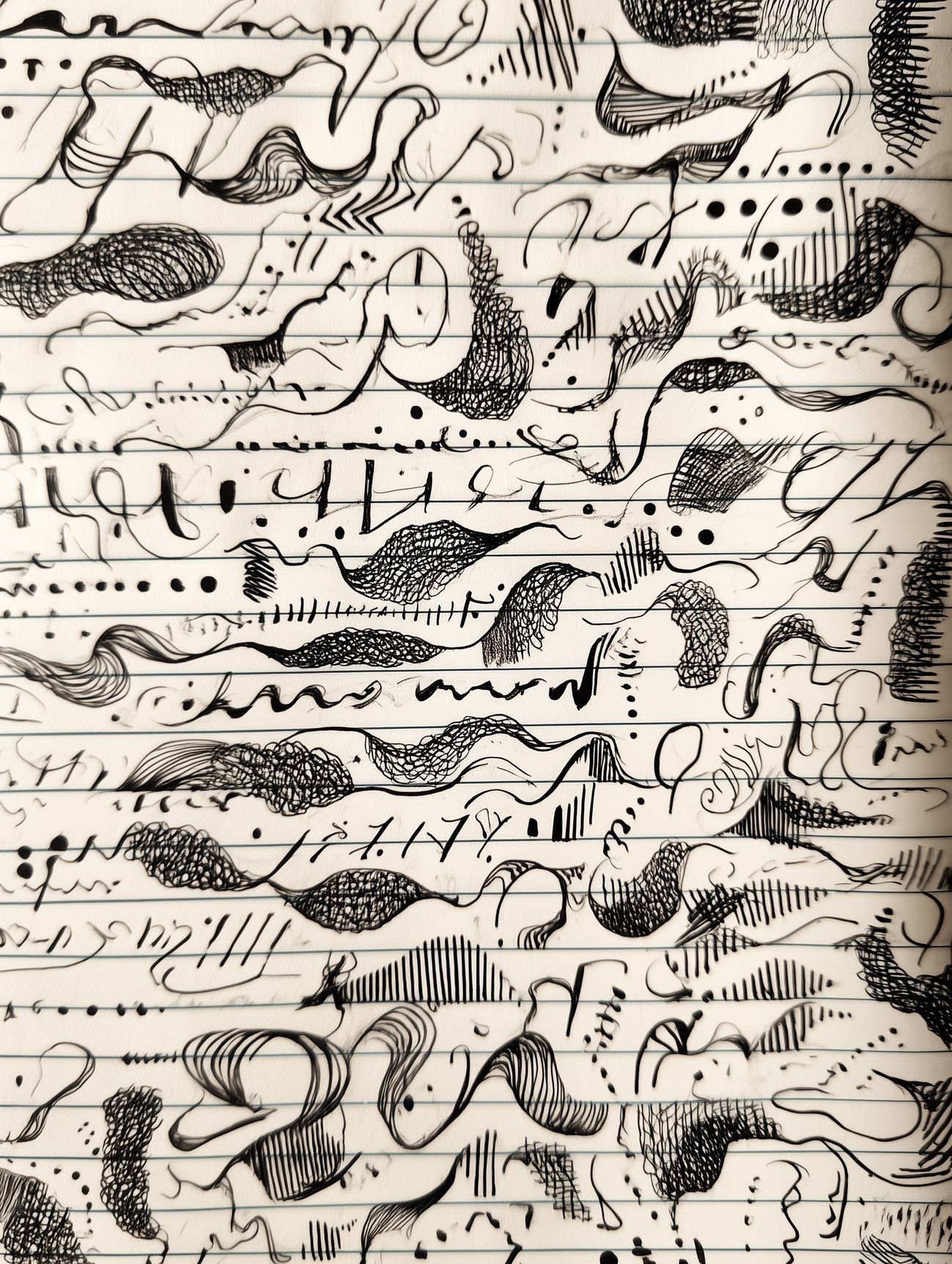
Textural drift into pure gesture. The script dissolves into sinuous channels, tuberous folds, and retinal trails. Micro-patterns in certain loops recall the structure of collapsed alphabets—perhaps a visualization of forgetting, or linguistic erosion under Martian conditions.
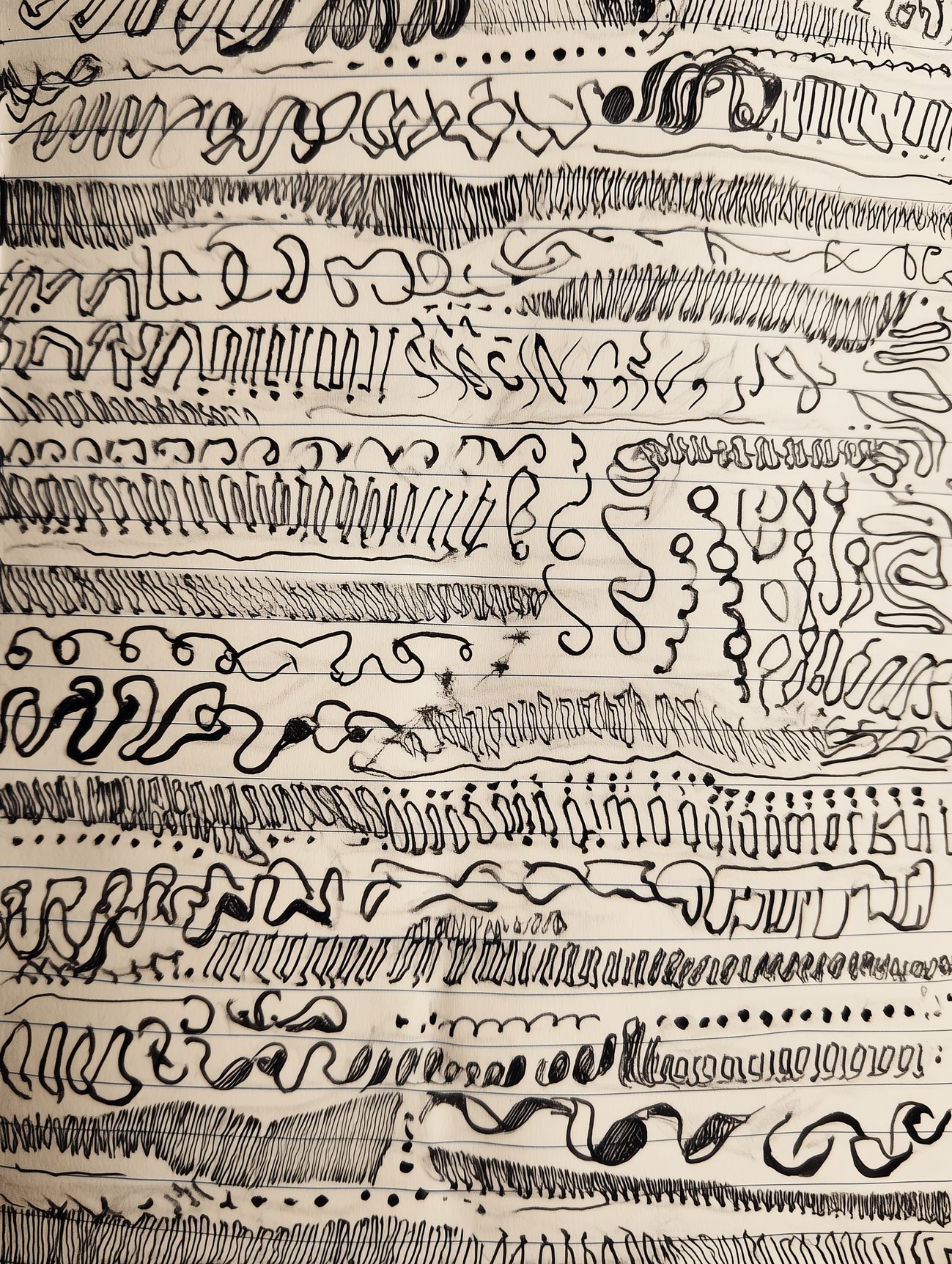
This page is among the most emotionally charged, with text-like curves pierced by dotfields and fractured grids. There are echoes of asemic calligraphy, and a signature-like flourish bottom right—that some interpret as a self-designation in a Martian creole.
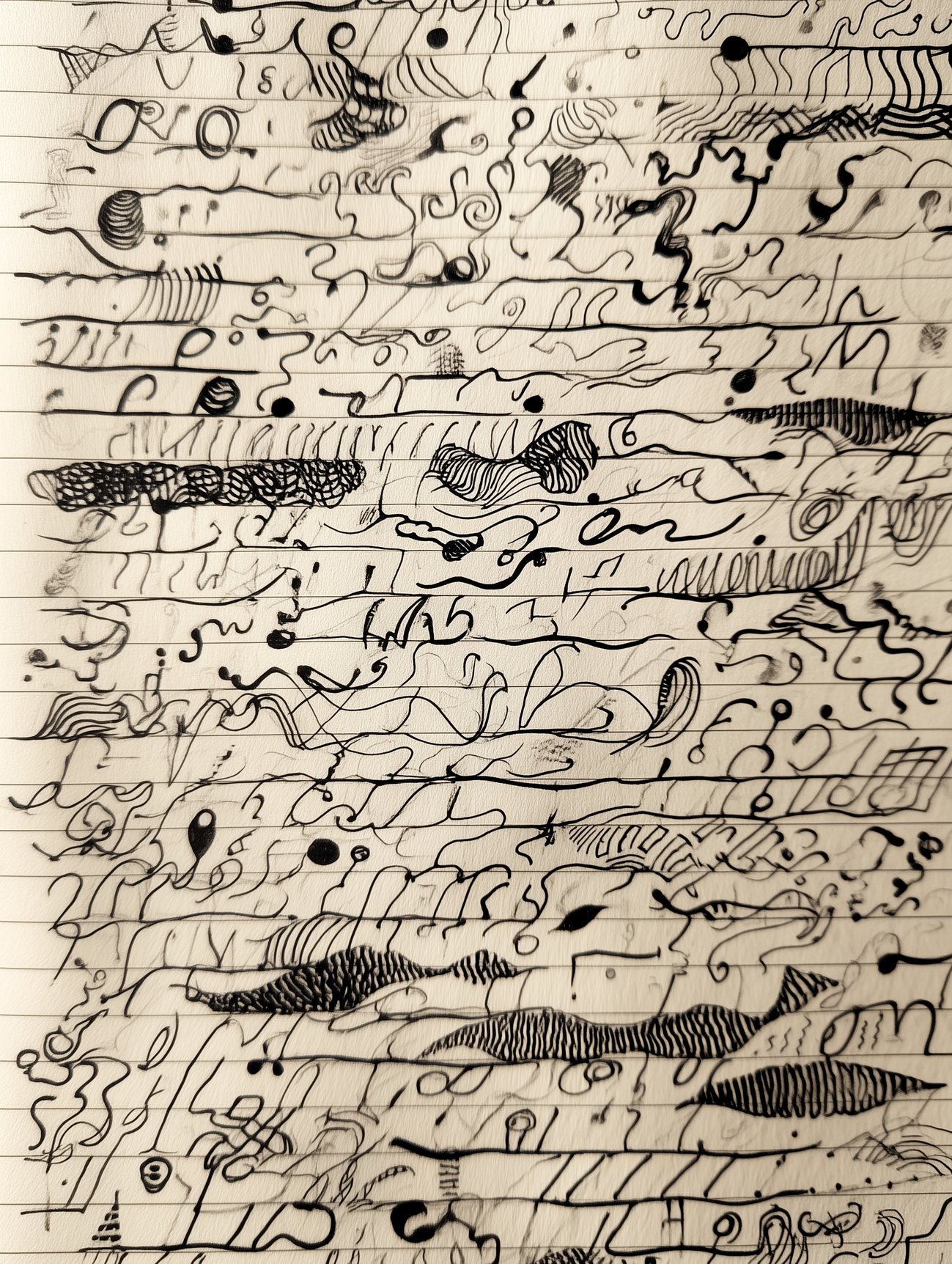
A cascading score of glyphic fragments and inked orbs, evoking the transcription of whispered sound through unstable atmosphere. Lines rise and splinter, resembling early attempts at phonetic weather-mapping. Punctuated nodules drift from left to right like migrating phonemes. Visual theorists have likened this format to alien sheet music or encrypted kinetic poetry transmitted via airwaves.
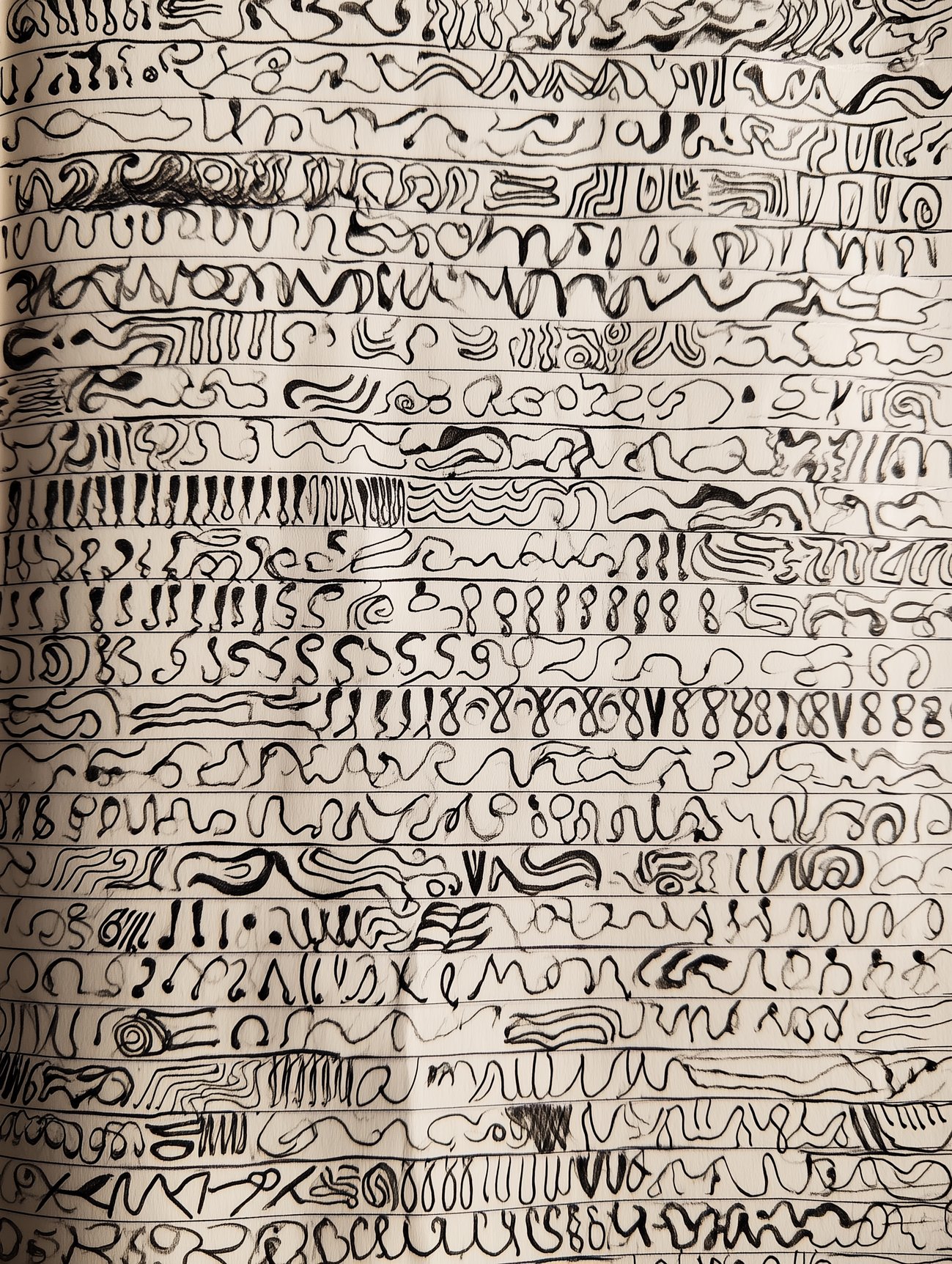
A dramatic departure into dual-color notation, where bright violet spheres anchor sprawling filament trails that seem to stitch together otherwise untethered cursive gestures. Layers of graphite script bleed beneath the surface, suggesting palimpsestual memory or recitation through damaged signal. The composition invites comparison to synaptic diagrams or vascular linguistic systems, especially in the visual theology of Emma Kunz.
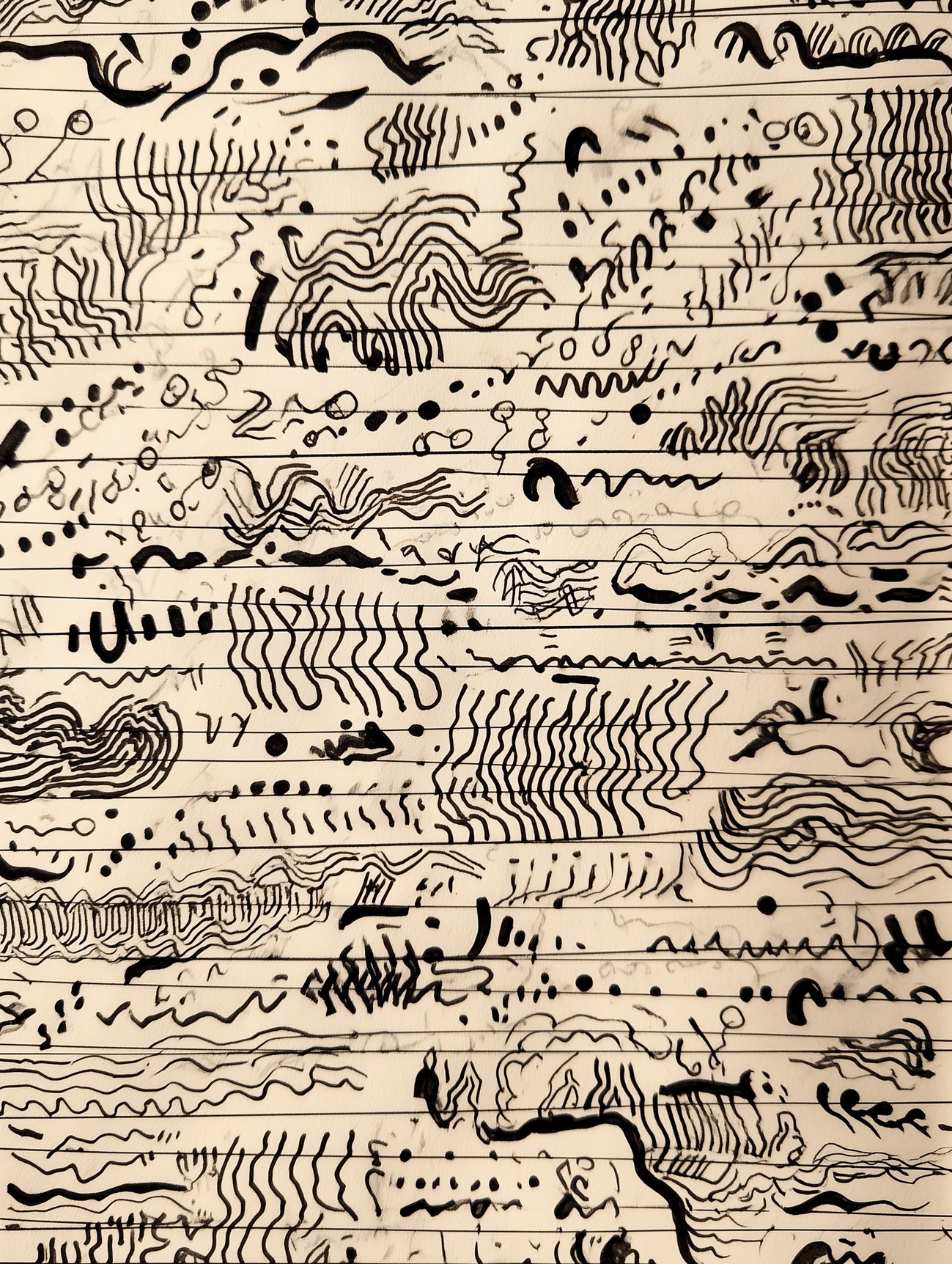
Dense accumulations of concentric rings and tangled capillaries mark this page as one of the most structurally complex. Certain glyphs bloom outward in whirlpools of motion, while linear trails connect them like speech-paths in a labyrinthine sermon. The glyphs function as both mouth and echo, potentially encoding reciprocal utterance or a scriptural recursion loop. Resembles the cosmographic language experiments of Paul Laffoley.
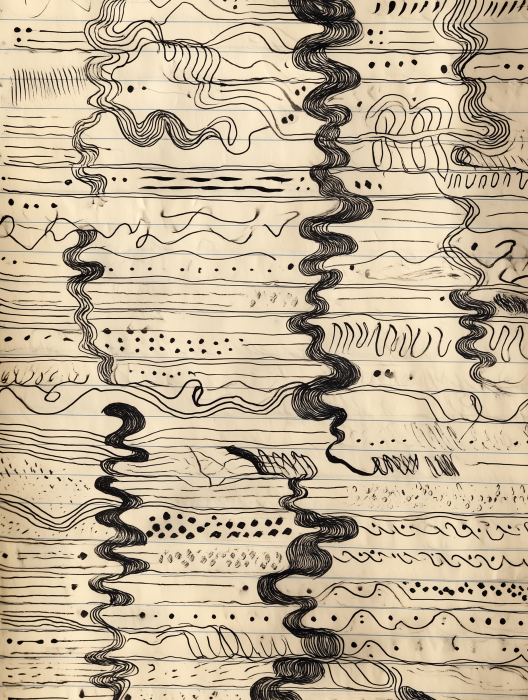
An exercise in horizontal layering and calligraphic mutation, this page repeats sinuous glyphs in elongated bands that stretch like sonic sediment. Each layer exhibits subtle deformation, as if eroded by time or misremembered through repetition. The rhythmic density varies dramatically, recalling analog waveform decay or whispered dictation under pressure. Scholars have noted parallels with Buddhist chant notation scrolls.
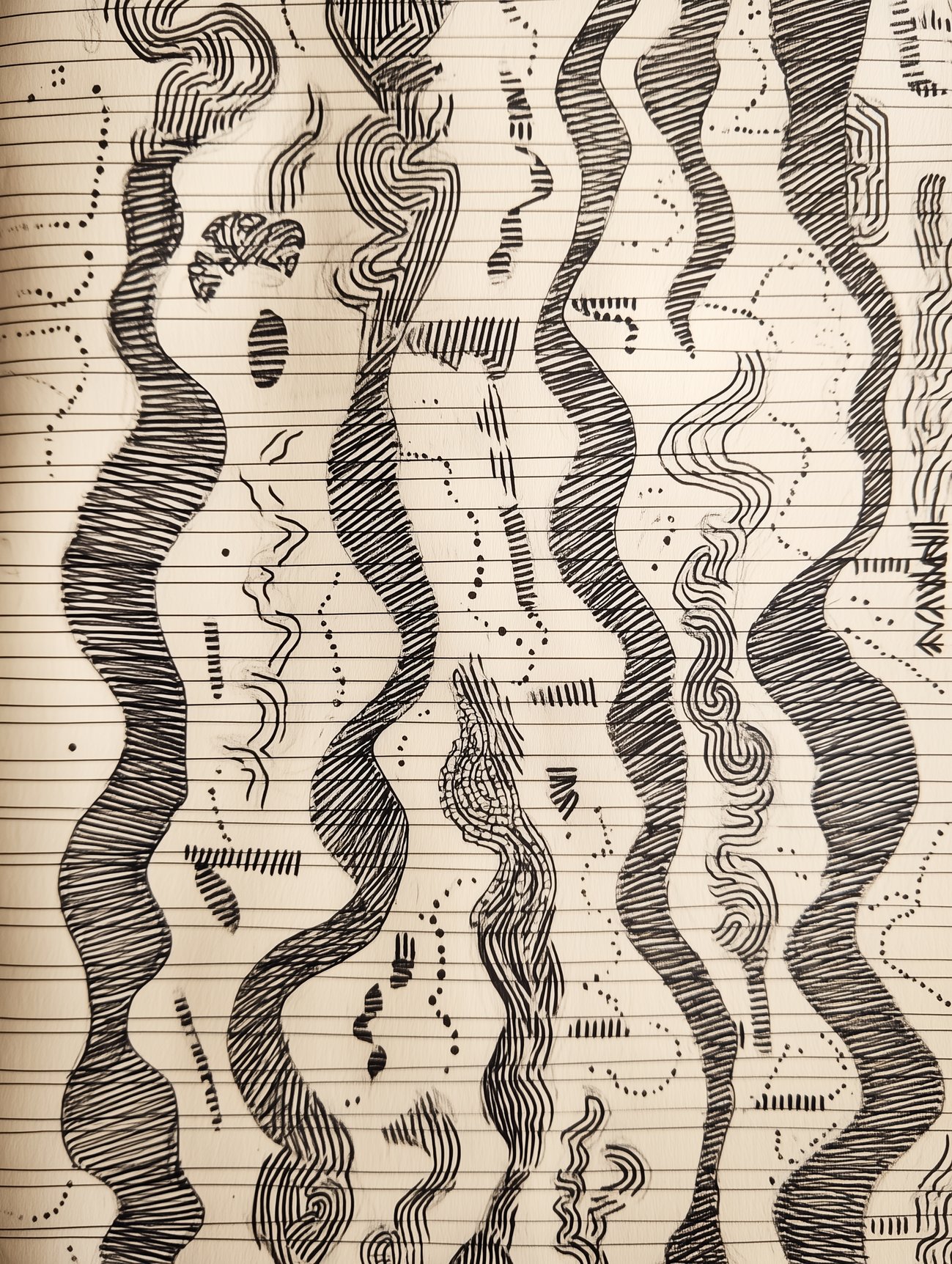
Bisected vertically by thick seismic waves, this page operates as a visual faultline between dueling syntactic orders. The blackened cords undulate through the composition like tectonic speech events, tearing across thinner strata of micro-glyphs and tonal dots. The effect is cartographic, as if mapping the language itself as a geographic terrain—a resonance with Ursula Le Guin's concept of 'telling' as terrain-building.
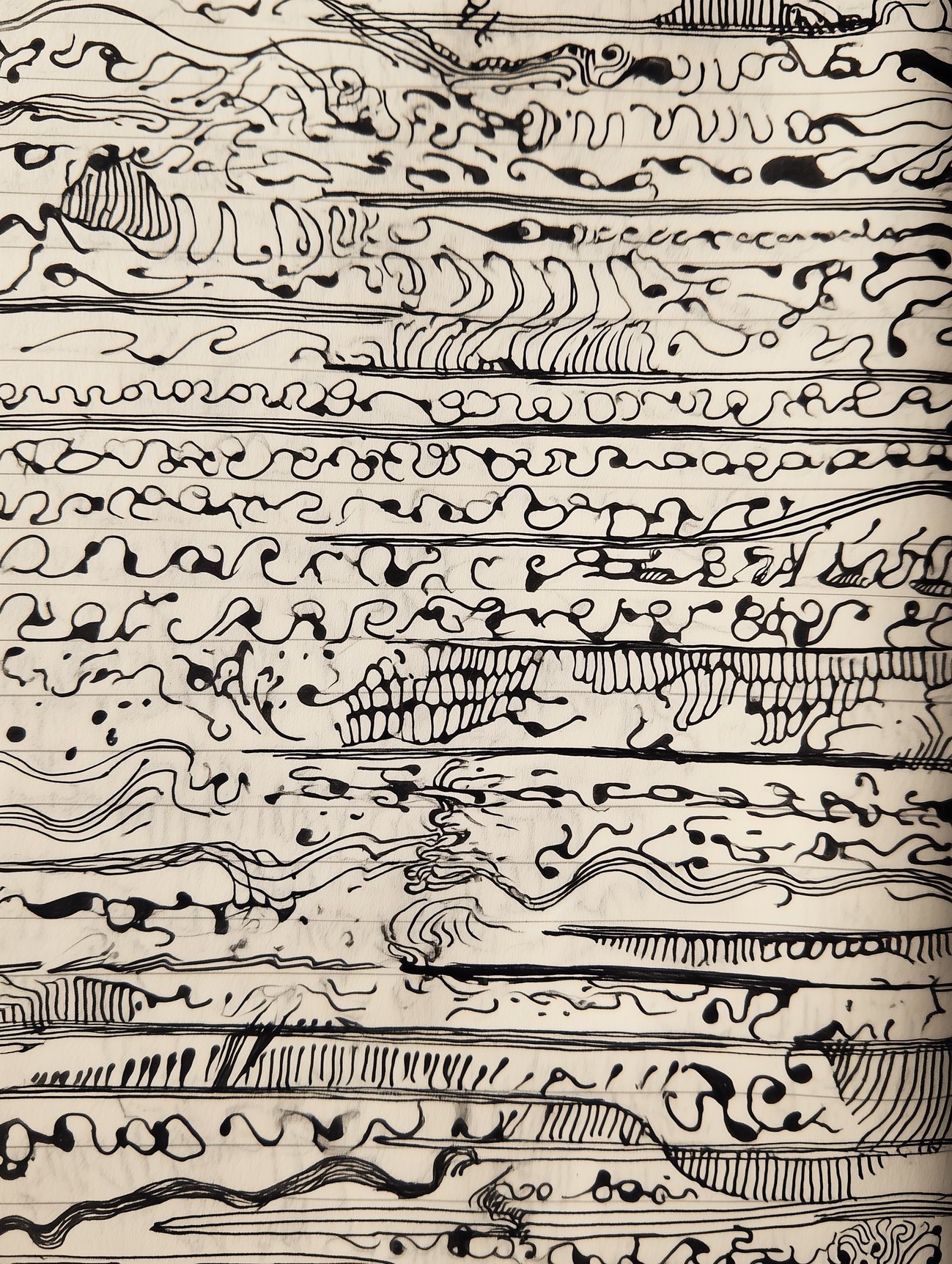
Dozens of looped, coiled, and broken glyphs flow in structured rows, each line presenting a new mutation of the same genetic glyph-seed. Curves morph into hooked crescents, bifurcated tails, or rootlike bursts, generating a sense of evolutionary calligraphy. The consistency of spacing suggests a taxonomic impulse, perhaps a glypharium or table of visual conjugations. Resembles a Martian equivalent of a proto-alphabetic periodic table.
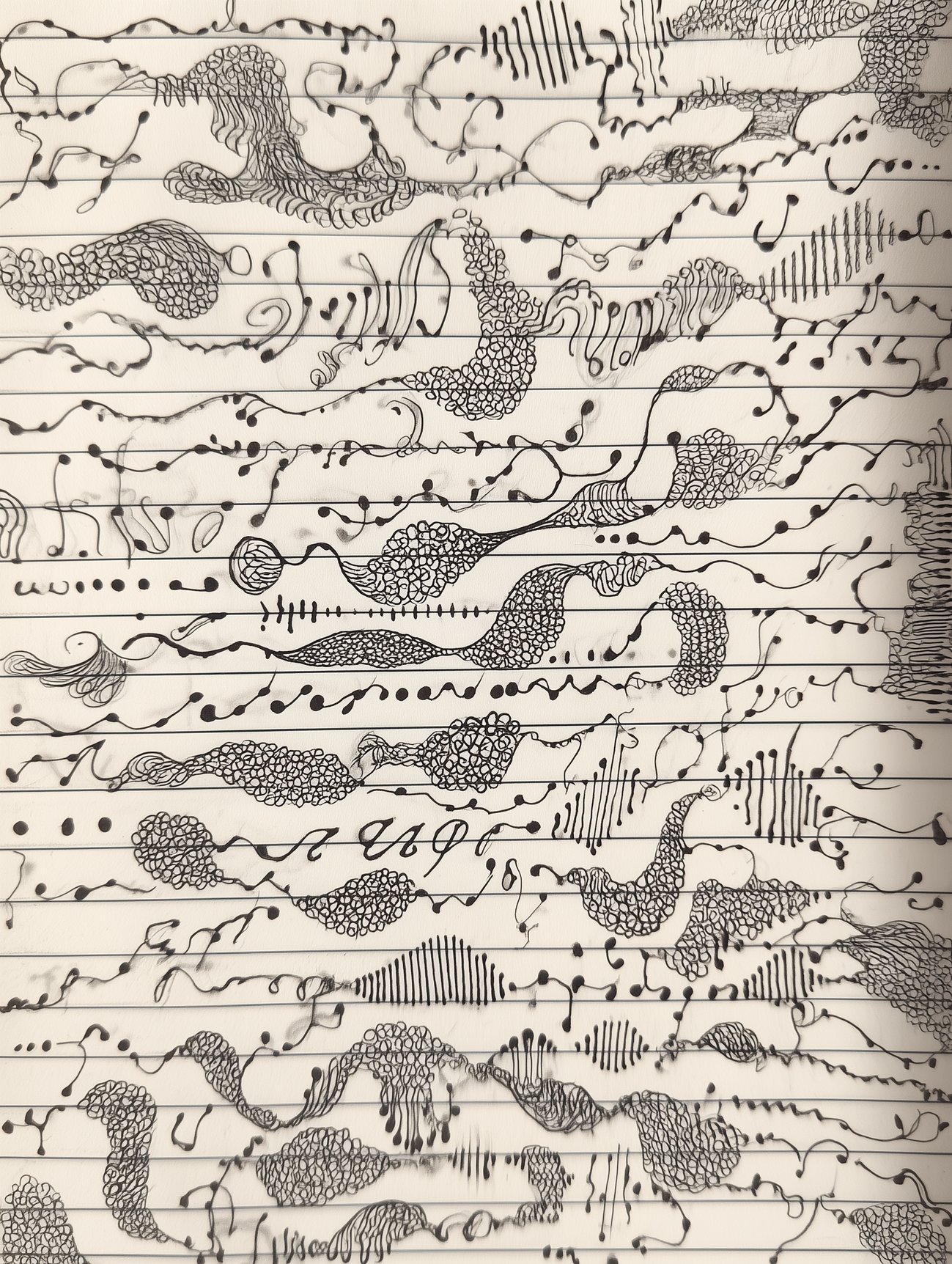
Fungal clusters of dot-laced filament emerge from swelling cellular nests, each shape recalling cross-sections of spores, alveoli, or encoded mycelia. Lines shimmer with respiratory breath or aquatic movement. This page is often cited as the most biomorphic in the series, its forms evocative of both neural maps and coral polyps. Some researchers believe it depicts a form of living script—language as a tissue or growth process.
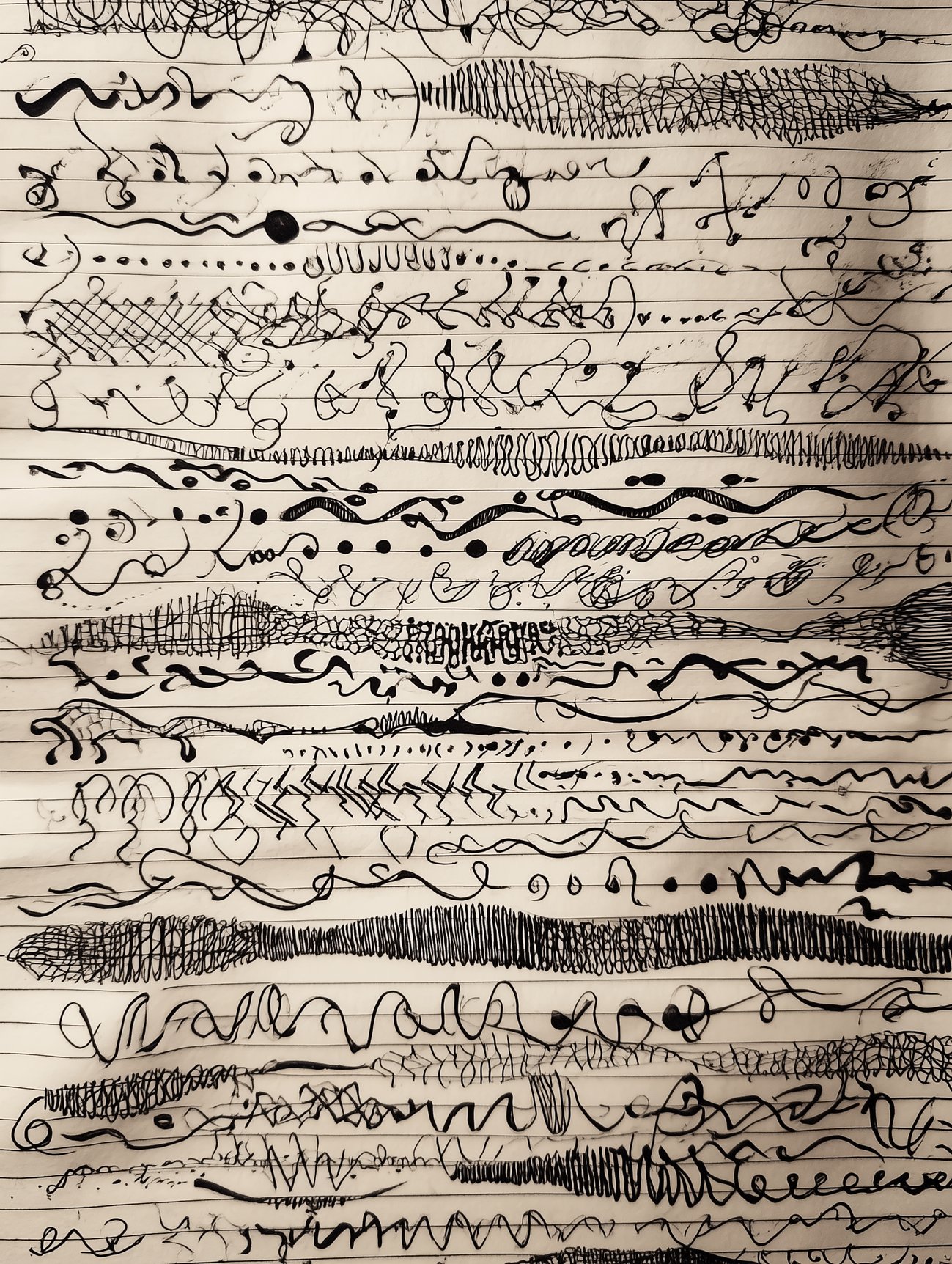
High contrast between thick strokework and delicate filament lines defines this page's emotionally volatile surface. Language appears to unravel, dance, or shout depending on the segment—an expressive fugue of scriptural attitude. Certain passages vibrate like the 'shiver lines' in Tantric scrolls, while others resemble the disturbed tracks of a seismograph. The page may represent a conversation between multiple internal voices.
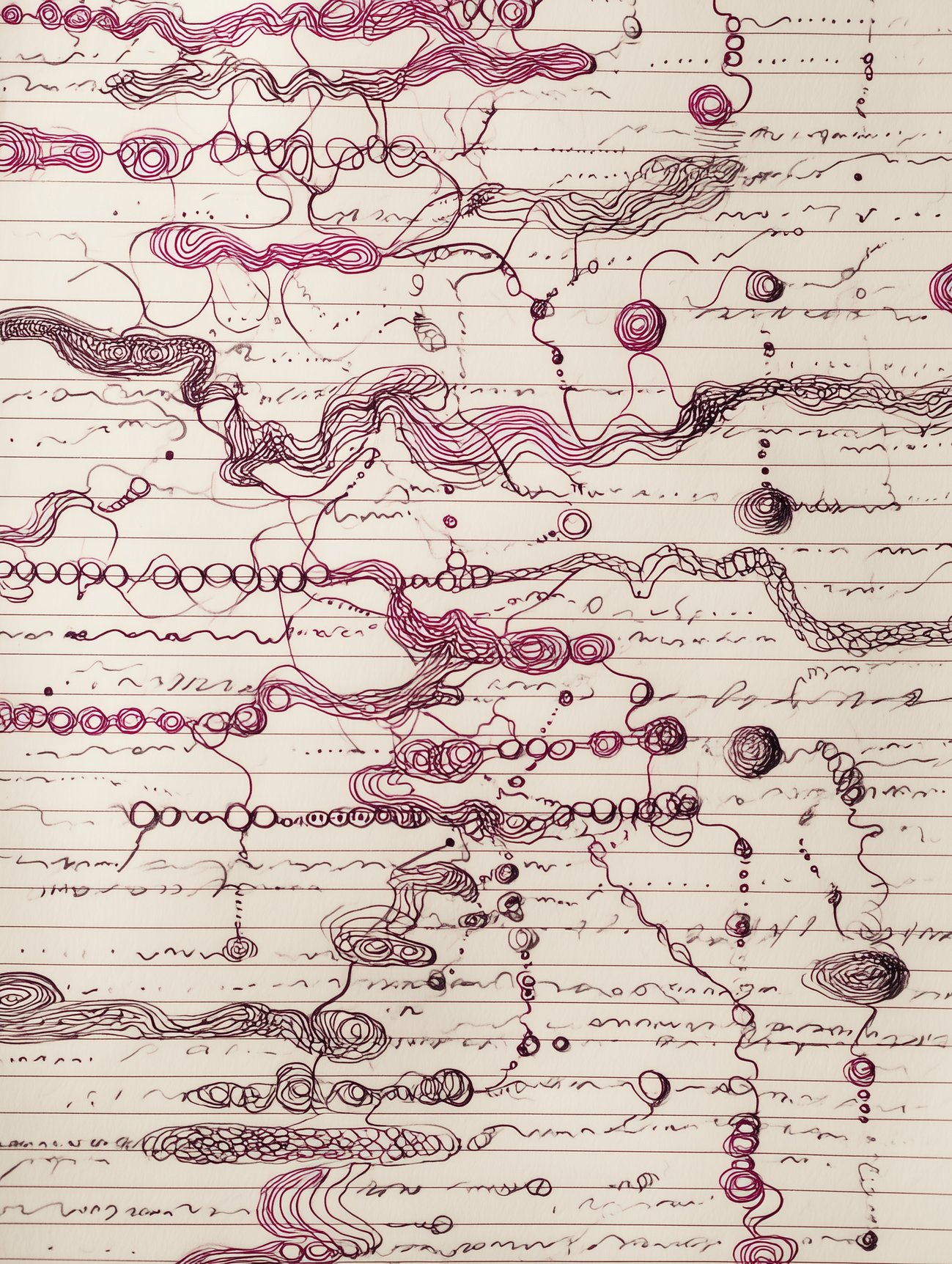
Perhaps the most taxonomical entry in the manuscript, this page lists rows of repeating glyphs—each slightly varied, as if undergoing morphological drift. S-like figures evolve into eights, loops into figure-eights, hooks into bifurcations. The rigor and linearity give the sense of a linguistic census, or the inventory of a collapsing phonemic system. Reminiscent of the script training charts produced in isolationist monasteries.
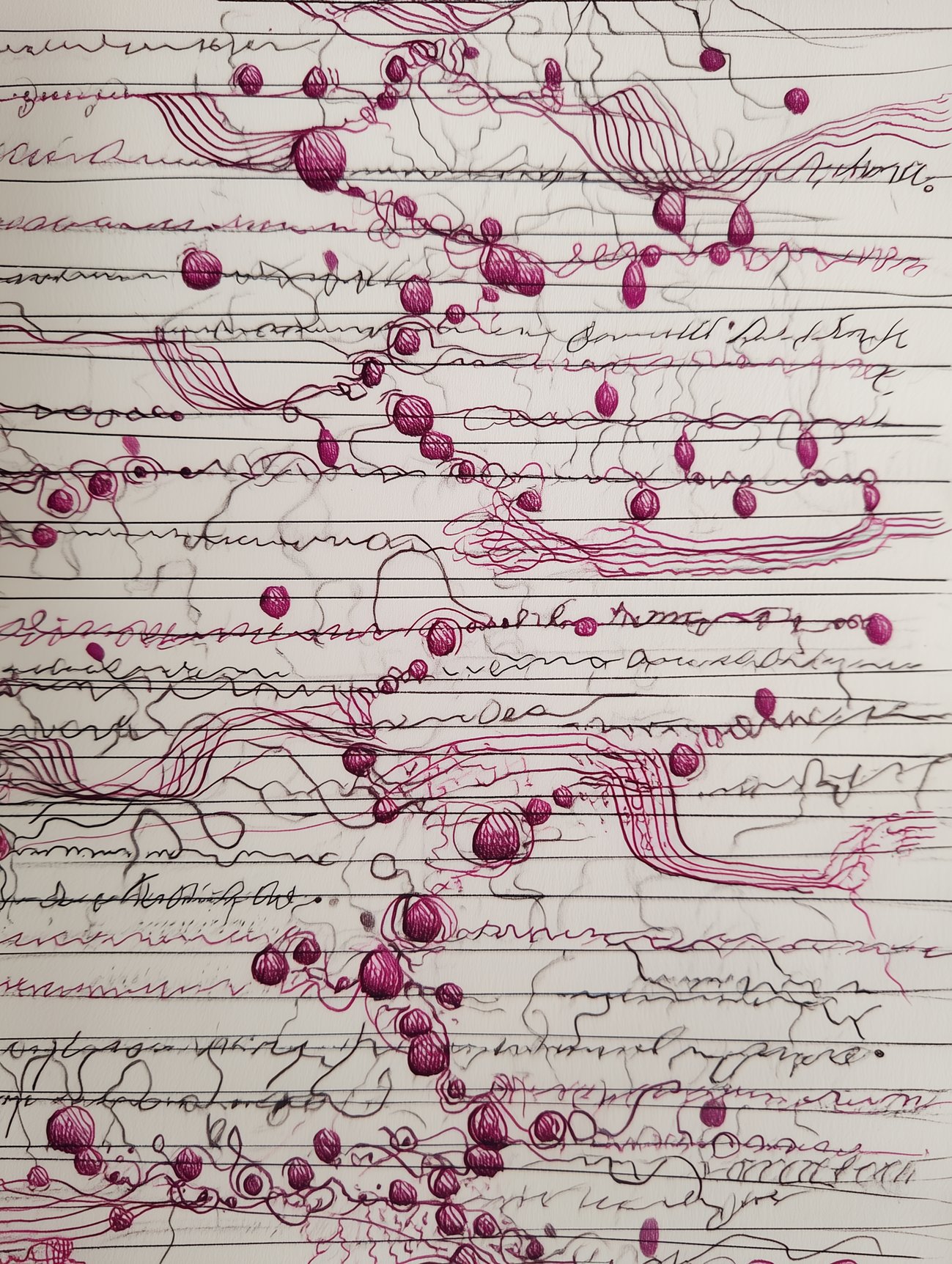
A field of recursive spirals and entropic mark clusters, with the bottom half collapsing into density and curvature, as if the page itself were pulled into a vortex. Line variation is extreme—some flickering like candle smoke, others dragging like geological strata. The final lines feature drooping, disconnected fragments, leading some scholars to read this as a farewell page, or the closing silence after the last word is lost.
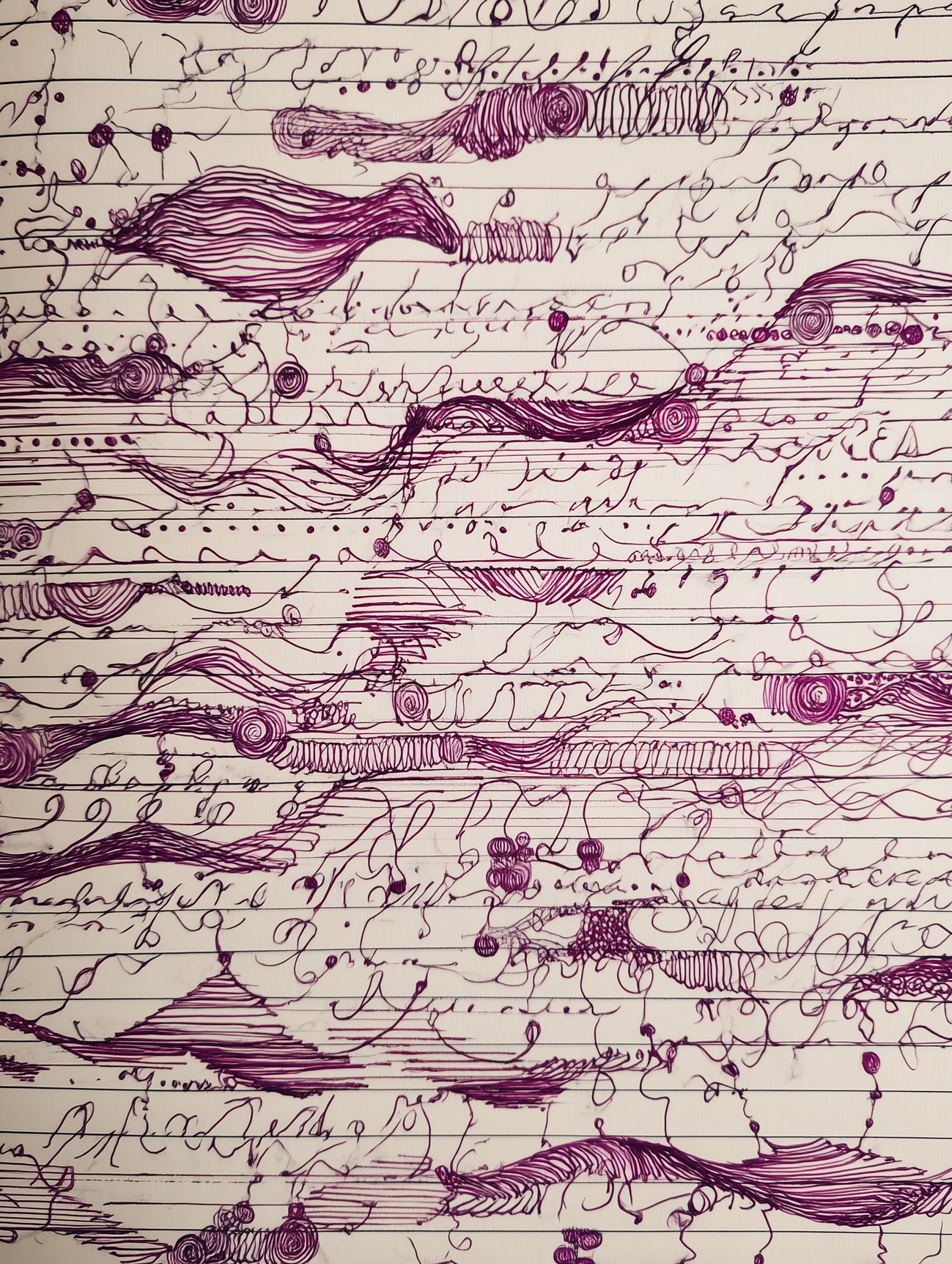
Purple cursive forms that most closely resemble conventional handwriting—yet remain entirely unreadable. Wave-crests and spiral nodes punctuate what might be sentences. This folio is the one most likely to produce the sensation of imminent decipherment, a feeling that lasts precisely until you try.
The ache of almost-meaning. The Kneverline at its most seductive.
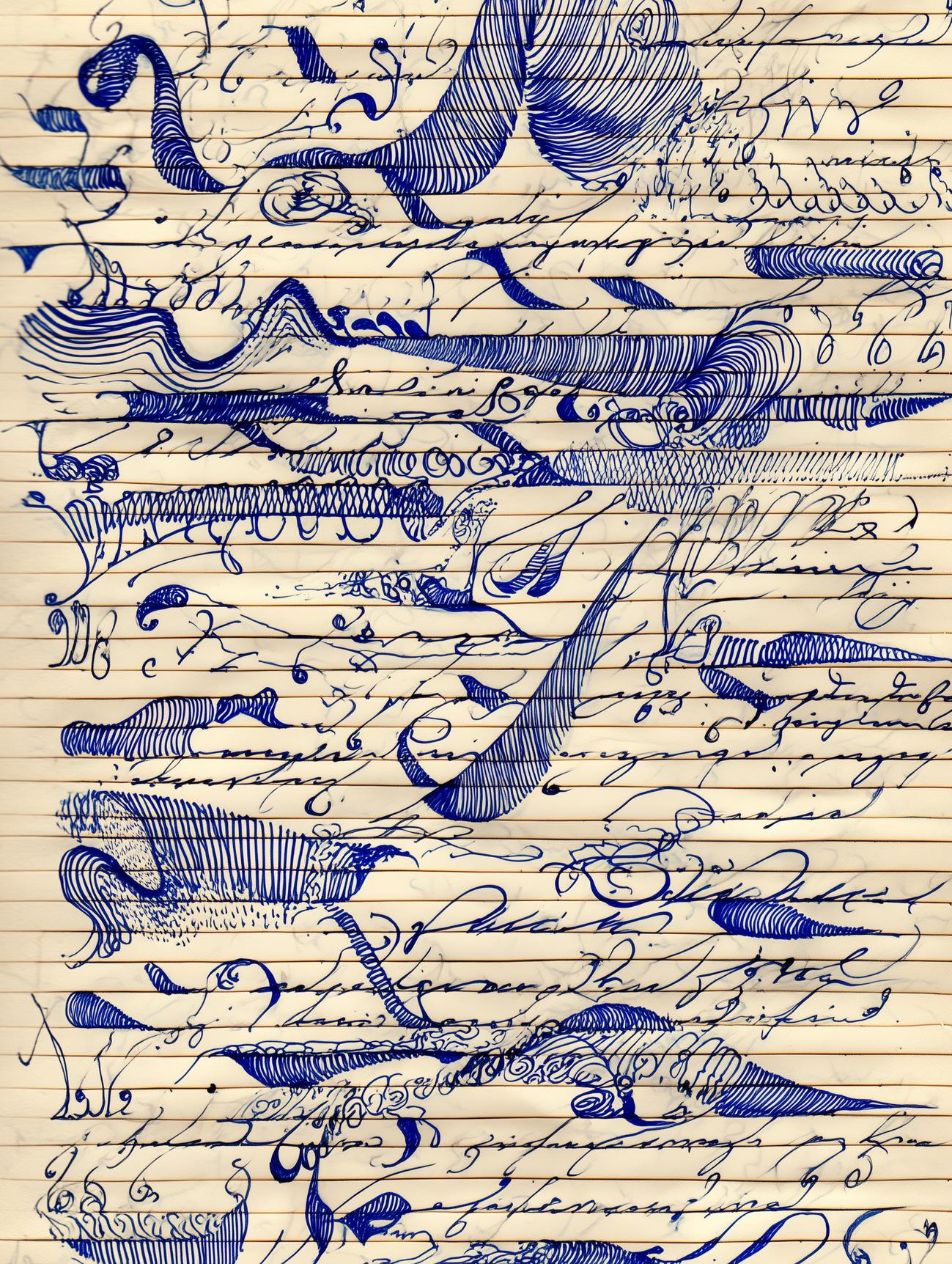
Blue ink, the most ornate folio. Dense scrollwork and calligraphic flourishes dominate the upper half—massive forms that suggest a trained hand, a schooled calligrapher who then proceeded to unlearn everything. Below: a cursive field of extraordinary regularity. The artist at peak fluency.
This is the folio that most convincingly argues these are letters. And then you look longer.
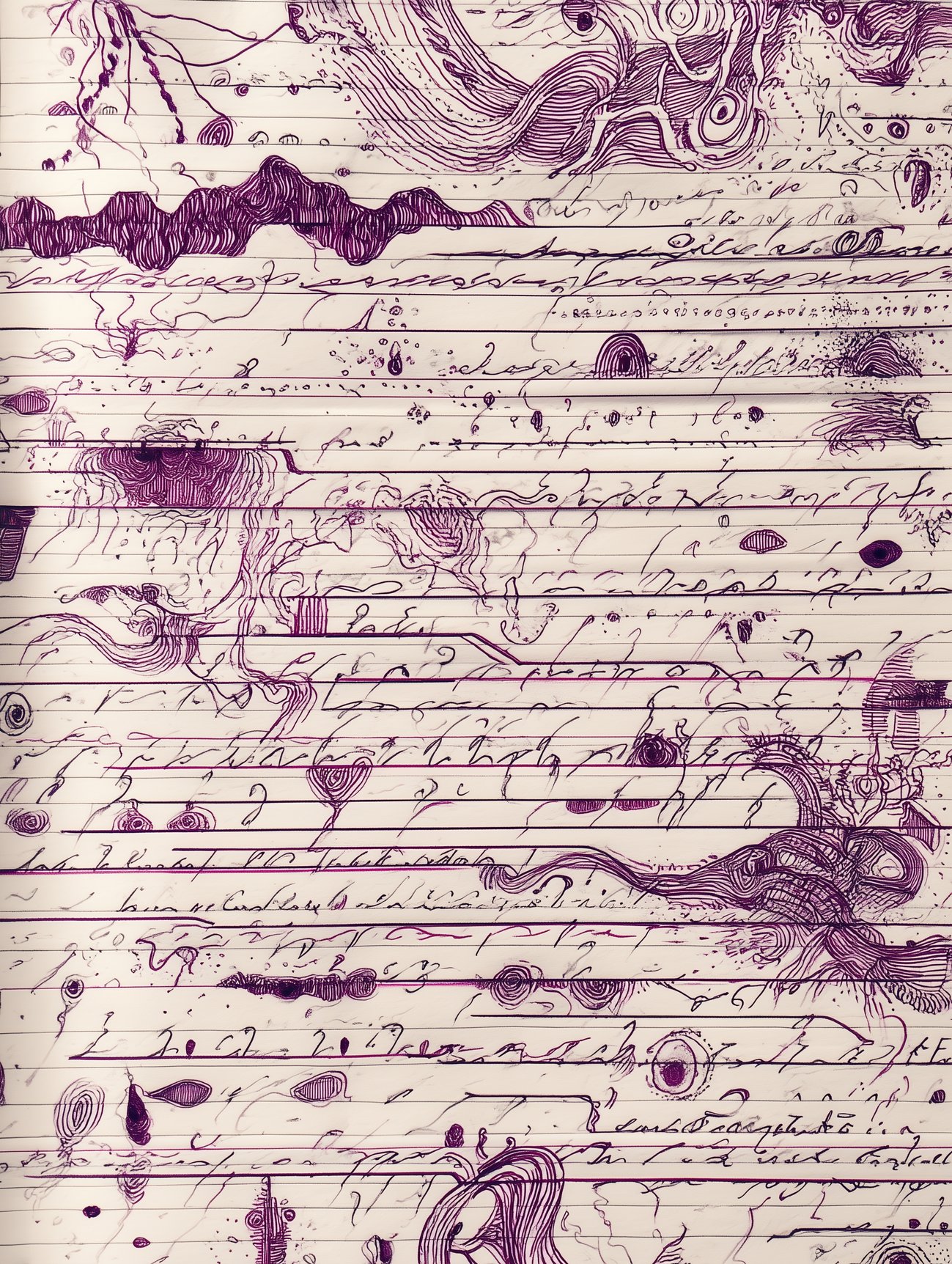
Eye-like forms with concentric irises stare from the margins. Topographic mountain-shapes in purple crowd the upper reaches. The only page in the codex that seems to look back. Iris and pupil are unmistakable. The artist has either embedded surveillance into the work, or the work has developed its own gaze.
Beneath the eyes: the same cursive script, now denser, more urgent. Something is being witnessed.
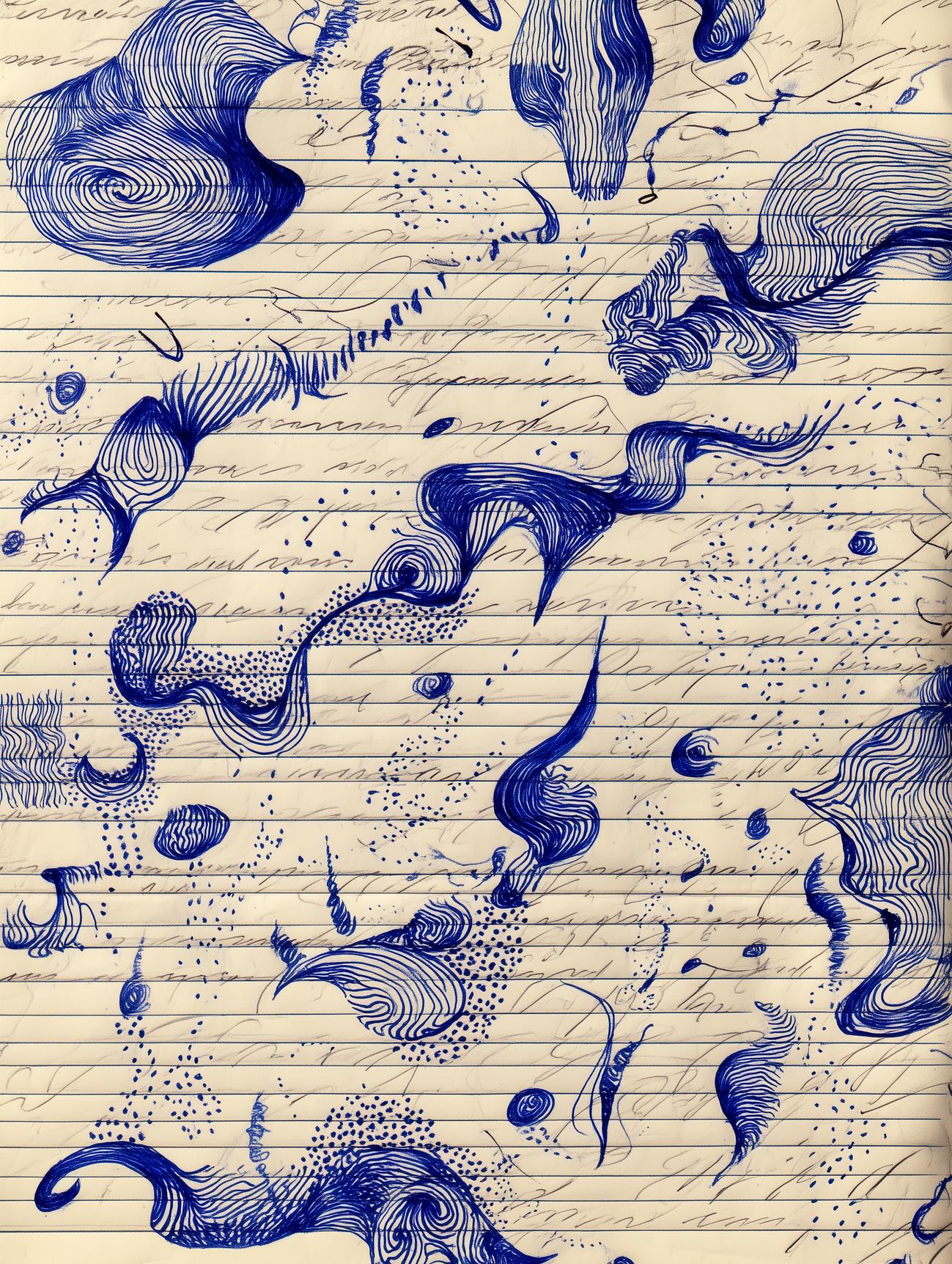
The final blue folio. Floating cloud-forms rendered in tight concentric spirals drift over a field of cursive script—like weather systems observed from above, or thoughts observed from outside a mind. The clouds are buoyant. They suggest lift. Departure. An atmosphere.
If this is the last page written, it ends not with conclusion but with float. The codex dissolves upward into something that cannot be transcribed.